Read More


A few months after an organization outsources a critical operation, an executive opens the monthly service review.
The dashboard looks reassuring.
Ninety-nine percent of transactions were processed on time. Service levels are green. The provider has met nearly every contractual measure.
And yet, the business is frustrated.
A significant exception has been unresolved for days. Several teams are involved, but nobody is quite sure who has the authority to make the decision. The provider believes the issue sits outside its scope. The internal team assumes the provider owns it. The people who would have known how to navigate the problem before outsourcing are no longer in the room.
The SLA is green. The service is not working.
While this scenario is not always the case, its probably more common than you think. It spans all segments of the buy-side: wealth and asset management. Small shop. Big shop. EMEA and North America.
This is one of the paradoxes of outsourcing. Organizations can successfully transfer the work while unintentionally weakening their ability to govern the outcome.
The difficult part of outsourcing is not simply deciding what leaves. It is deliberately designing what remains.
At InvestOps Connect 2026 — West Palm Beach, FL, Mark Aguilera presented that distinction and summarized simply:
"Outsourcing changes what you operate. It does not eliminate what you own."
After working through outsourcing and operating-model transformations, we see the same lessons emerge again and again.
Here are eight that matter most.
One of the first questions executives naturally ask when considering outsourcing is:
How many people do we still need?
It is an important question, but it is usually not the first one that should be answered.
The better question is:
What capabilities do we still need?
Before outsourcing, an operations team may be responsible for processing transactions, resolving exceptions, reconciling positions, managing data, and operating technology.
After outsourcing, much of that work may move.
But the organization still needs people capable of determining whether the service is working.
That requires a different skill set.
The retained organization needs to interpret service levels, identify patterns, challenge root causes, and manage escalations. It needs enough subject-matter expertise to distinguish a routine operating issue from an emerging systemic problem.
The objective is not to recreate the provider’s organization internally.
It is to retain enough capability to intelligently govern it.
This distinction sounds obvious until something goes wrong.
A provider can assume responsibility for performing an activity. But the client organization remains accountable for the consequences of that activity.
That creates a potential trap.
If too much operational expertise leaves the organization, management may eventually become dependent on the provider to explain whether the provider itself is performing well.
That is not oversight.
Effective governance requires enough retained knowledge to independently ask:
The goal is not duplicate staffing.
It is independent judgment.
Most outsourcing programs devote enormous energy to the transition.
There are workplans, staffing models, technology migrations, service descriptions, contractual schedules, and knowledge-transfer plans.
All of them focus, appropriately, on moving work safely.
But there is another operating model being created at exactly the same time: the retained organization.
That organization cannot simply be whatever is left after everything else moves.
Imagine an exception appearing the week after go-live.
Who owns it?
Who can approve a workaround?
Who owns the underlying data issue?
Who decides whether the issue belongs to the client, the provider, or another third party?
When should it reach executive governance?
A RACI may answer part of that question. But a RACI alone is not an operating model. Decision rights, governance forums, and escalation mechanisms have to work when a problem does not fit neatly into a predefined box.
The retained organization should be designed alongside the outsourced model, not after it.
One of the easiest things to measure after outsourcing is activity.
How many transactions were processed?
How quickly were exceptions resolved?
Was data delivered by the agreed cutoff?
Did the provider meet the contractual threshold?
Those measures matter.
But they are not the same as outcomes.
Consider a service operating at 99 percent accuracy. On paper, performance may look excellent. But if the remaining one percent contains the firm’s highest-value accounts, most complex instruments, or most consequential exceptions, the business may reasonably consider the service unacceptable.
Effective oversight should begin with the business outcome and work backward.
An organization can manage dozens of green SLAs and still have an unsuccessful service.
The question for leadership is not only:
Is the provider meeting its measures?
It is:
Is the service delivering the outcome we intended?
Most operating models work beautifully on normal days.
Trades settle. Data arrives. Systems run. Procedures cover the expected scenarios.
Then something happens that is not in the procedure.
A trade fails.
A critical feed arrives late.
A new business requirement crosses organizational boundaries.
An issue emerges that neither the contract nor the operating procedures clearly assigned to anyone.
This is where governance becomes real.
The important questions suddenly become less about process and more about authority:
Outsourcing models should not be tested only against the happy path. They should be deliberately tested against exceptions.
If nobody knows what happens when the procedure stops, the operating model is incomplete.
This becomes especially important when outsourcing involves restructuring, rebadging, or headcount reductions.
There is understandable pressure to realize the economic benefits of the new model quickly.
But some of the most valuable knowledge inside an operations organization has never been written down.
It sounds more like this:
“This account always behaves differently at month-end.”
“Watch this feed after a holiday.”
“That control exists because three years ago this happened.”
“If this breaks, call this person first.”
That institutional knowledge is accumulated through thousands of exceptions, conversations, and small decisions.
A procedure document rarely captures all of it.
Effective knowledge transfer therefore requires more than documentation. It can require deliberate overlap, shadowing, reverse-shadowing, exception inventories, and explicit exit criteria before knowledge transfer is considered complete.
Importantly, not all knowledge should leave.
Some knowledge should intentionally remain with the retained organization because it enables the organization to challenge, govern, and assure the service.
The technology may be complicated.
The commercial negotiation may be difficult.
The transition plan may contain hundreds of activities.
But some of the greatest risks sit with the people already doing the work.
When an organization announces an outsourcing initiative, employees immediately begin asking a question that may never appear on the project plan:
What does this mean for me?
The strongest people usually have options.
Prolonged uncertainty can cause precisely the institutional knowledge the organization needs for a successful transition to leave first.
Leadership therefore needs clarity about the principal talent paths:
People cannot always receive every answer immediately. But the organization should establish those answers as quickly as responsibly possible.
Talent transition is not simply an HR workstream. It is part of operational risk management.
At the end of a long outsourcing program, signing the contract can feel like the finish line.
It is not.
It is the beginning of what may be a five-, seven-, or ten-year operating relationship.
During that period, products will change. Volumes will change. Regulations will change. Technology will change. Business priorities will change.
No contract can anticipate every decision that will arise.
The strongest relationships operate at several levels simultaneously:
The real measure of the relationship is not whether the contract contains a mechanism for resolving every disagreement.
It is whether the organizations can resolve most disagreements without needing to pull out the contract.
The contract protects the relationship. Governance makes the relationship work.
The deepest change created by outsourcing is easy to underestimate.
The organization is not simply doing less.
It is doing something different.
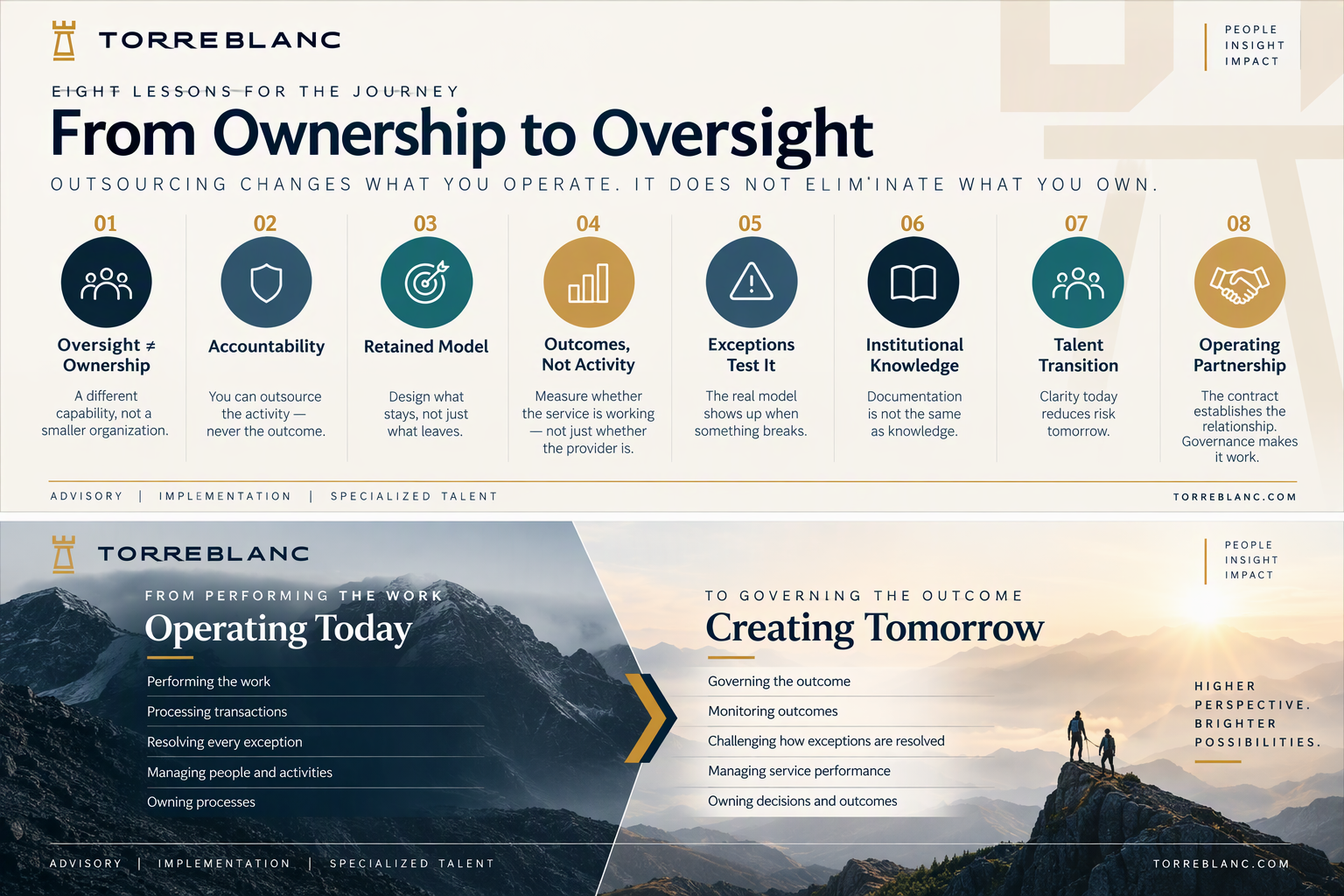
The operating model shifts from:
That requires a different kind of organization.
A successful outsourcing model does not mean the client should know less about its operation.
It means the client needs to know different things:
The question executives should ask before outsourcing is not simply:
Are we ready to move the work?
It is:
Is the organization we are leaving behind ready to govern it?
Because successful outsourcing ultimately comes down to three things:
Outsource the execution.
Retain the expertise.
Govern the outcome.
About the author
Mark Aguilera is the Founder and CEO of TorreBlanc, an investment-management consulting firm specializing in operating-model strategy, transformation, implementation, and specialized industry expertise.
This article is based on themes presented at InvestOps Connect 2026 in West Palm Beach, Florida.