Read More


In the plumbing of the financial system—largely invisible to most investors—few tools are as consequential as the reverse repurchase agreement, or reverse repo. Despite the technical name, the concept is straightforward. And for anyone operating in investment management, understanding how these instruments work is less an academic exercise than a prerequisite for understanding how the system actually functions.
A reverse repo is a short-term, collateralized loan—viewed from the lender's perspective.
One party lends cash. The other provides securities as collateral, typically government bonds. The borrower agrees to repurchase those securities at a slightly higher price at a specified future date, usually the next day. That price difference is the interest earned—the repo rate.
Put plainly: I lend you cash today. You give me safe collateral. You pay me back tomorrow with a small return.
Every repo transaction has two sides. What one party calls a repo, the other calls a reverse repo. It issimply a matter of perspective.
The mechanics are easier to follow with a concrete example.A money market fund holds excess cash. A bank needs short-term liquidity. The fund lends cash to the bank; the bank provides U.S. Treasury securities as collateral; the next morning, the bank repurchases those securities at the agreed higher price. The fund earns a low-risk return. The bank secures temporary funding. The transaction settles and resets—often daily.
This simplicity is the point.Reverse repos are overnight or very short-term by design, which makes them highly flexible and widely used.
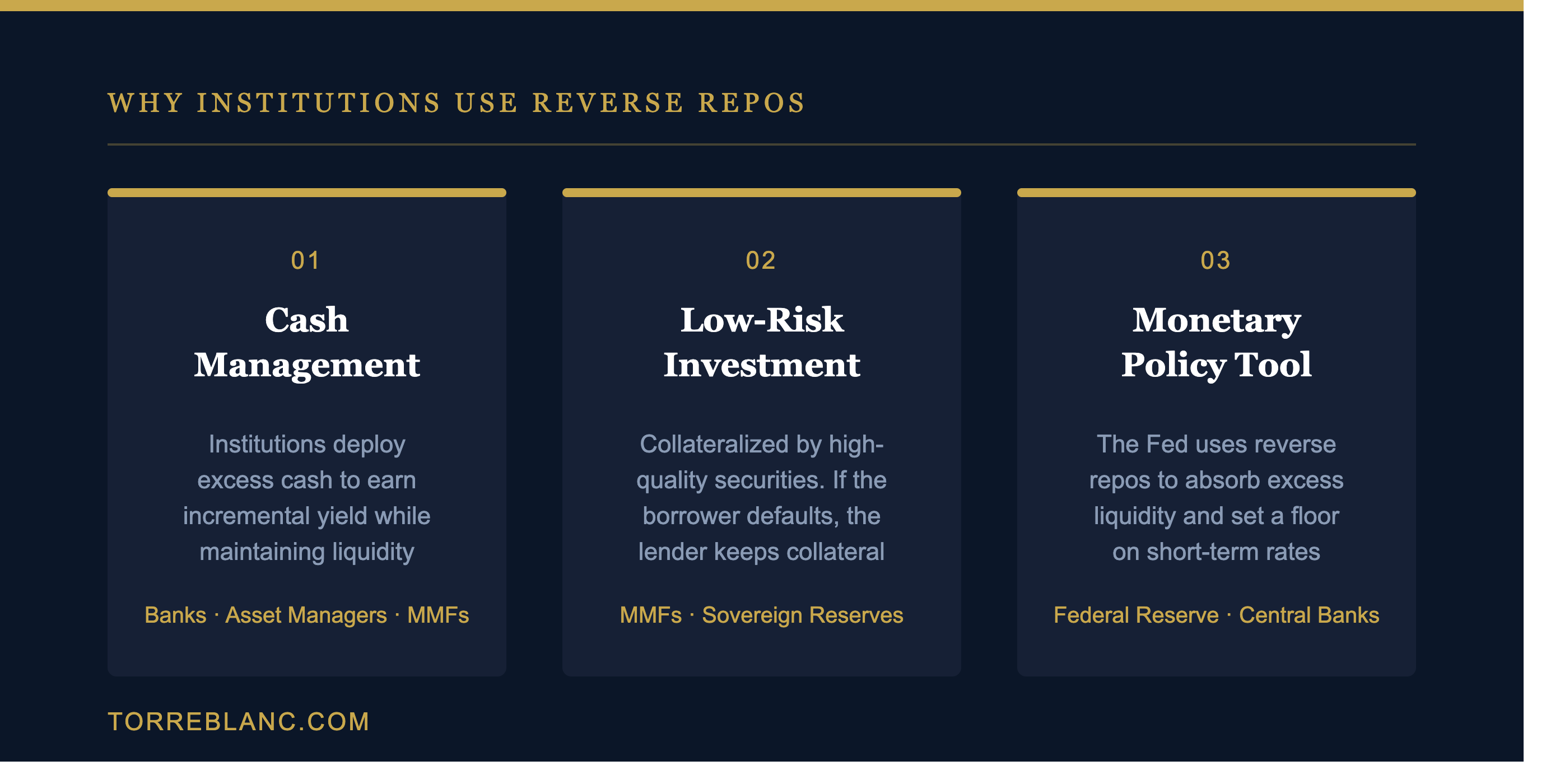
Large financial institutions—banks, asset managers, money market funds—rarely leave significant cash idle. When they hold excess cash, reverse repos allow them to put it to work safely: earning incremental yield, maintaining liquidity flexibility, and avoiding the drag of unproductive cash sitting on the balance sheet. When they need cash, they enter the repo side of the trade.
Reverse repos are attractive precisely because of their risk profile. The cash is collateralized by high-quality securities. If the borrower defaults, the lender keeps the collateral. For money market funds, sovereign reserves, and corporates managing liquidity, this makes reverse repos function like a secured deposit with enhanced protections—one of the safest short-term investment vehicles available.
This is where reverse repos move from operational to strategically important.
Central banks—including the Federal Reserve—use reverse repos as a deliberate monetary policy tool. When excess liquidity builds in the financial system, short-term rates tend to fall as institutions scramble todeploy cash. The Fed's reverse repo facility provides an outlet: institution spark excess cash with the central bank, which prevents rates from dropping too far and destabilizing money market conditions.
The effect is a floor. By absorbing surplus liquidity through reverse repos, the Fed anchors short-term rates and supports the broader transmission of monetary policy. In periods of market stress or excess liquidity—such as post-quantitative easing environments—reverse repo usage can surge dramatically, which is itself a signal worth paying attention to.
There is a dimension of this conversation that often goes under discussed. Firms that participate in repo and reverse repo markets—whether directly or through prime brokerage and cash management arrangements—face real operational complexity. Positions require precise daily reconciliation.Collateral movements must be tracked, substitutions managed, and margin calls settled on tight timelines. Across multiple counterparties, custodians, or platforms, the middle- and back-office burden compounds quickly.
We regularly see firms whose trading strategies have outpaced the infrastructure supporting them. In repo markets, the cost of that gap is not theoretical—it shows up in breaks, fails, and exposure that is harder to detect and manage than in more straight forward asset classes. Operational due diligence in this space is not a box-checking exercise. It is a core risk management function.
Reverse repos may read as plumbing. But they are load-bearing plumbing.
They allow cash to move safely and efficiently through the financial system. They give central banks a precise lever over liquidity and short-term rates. And they sit at the intersection of cash management, monetary policy transmission, and financial system stability in a way that few other instruments do.
For firms operating in or around these markets, understanding reverse repos is not optional background knowledge. It is understanding how the system actually works—and where the pressure is, or isn't, building.
Salvatore Auditore
Managing Consultant
TorreBlanc