Read More


TorreBlanc is pleased to announce our latest vendor profile featuring SMArtX Advisory Solutions. Many members of our team have worked closely with the people behind SMArtX long before they came together under the SMArtX banner, giving us deep familiarity with their experience, thinking, and approach. That history, combined with SMArtX’s strong alignment with our goal of helping wealth management clients modernize and scale their businesses, makes us especially excited to present this content and share their story with you.
Alex Thompson, Chief Product Officer
Alex Thompson is the Chief Product Officer at SMArtX Advisory Solutions, where he drives product vision, strategy, and execution across the firm’s award-winning managed accounts platform. With a focus on innovation and scale, Alex partners with technology, design, and client teams to deliver solutions that redefine how wealth management enterprises adopt and grow managed account programs. Under his leadership, SMArtX has pioneered new capabilities in unified managed accounts, alternative investments, and data-driven advisor tools, positioning the platform at the forefront of next-generation wealthtech.
Alex’s career spans nearly two decades of building financial technology and investment platforms. He joined HedgeCo Networks in 2009, where he focused on investment research and due diligence for alternative investments, eventually rising to the ranks of EVP at HedgeCo Securities. He went on to launch HedgeCo Investment Management, where he and his team identified talented but undiscovered hedge fund managers and managed a multi-strategy fund vehicle to provide them with seed capital. Earlier in his career, Alex was a product manager at JMT Software, developing solutions for electronic health records and medical research that required navigating complex data and regulatory environments, an experience that continues to inform his approach to wealth management technology.
Aaron Wormus, Chief Technology Officer
Aaron Wormus is the Chief Technology Officer at SMArtX Advisory Solutions, driving the firm’s technology strategy and platform architecture. He has extensive experience developing financial technology solutions for the advisory and alternatives sector.
Before SMArtX, Aaron led the online division of HedgeCo Networks, where he developed a pioneering SaaS platform for hedge fund clients. As Chief Architect of HedgeCo.Net, he built a hedge fund database tracking over 7,000 funds and designed analytical tools such as the Hedge Fund Calculator. He also worked as an independent technology consultant across various industries.
Aaron continues to lead advancements in SMArtX’s technology to optimize efficiency and enhance user experience.
SMArtX was not born out of the traditional wealth management technology ecosystem. It was built from the inside of the hedge fund and capital markets world, where complexity, scale, and precision are non-negotiable. The platform’s origins trace back to HedgeCo, an institutional firm deeply embedded in hedge fund operations, trading infrastructure, capital formation, and portfolio data, long before managed accounts became a strategic priority for wealth firms.
The original inspiration was to solve a problem that few technology providers were even attempting at the time: how to take real-time hedge fund trading activity, sourced directly from prime brokers and execution systems, and replicate it accurately at the individual account level. Doing that required building a real-time trading engine, native sleeve-level portfolio accounting, tax-aware allocation logic, and institutional-grade data normalization from day one. There were no shortcuts, and there was no legacy platform to retrofit.
Only after the technology was live did something unexpected happen. Wealth advisors began adopting the platform aggressively, not because it was marketed to them, but because it could finally handle the complexity they were already dealing with. Multiple strategies in a single account. Customization. Scale. What started as hedge fund replication technology quickly proved to be a far more powerful foundation for managed accounts than the legacy systems dominating the wealth management market.
That realization led to a strategic pivot. Rather than simplify the technology to fit existing market norms, SMArtX leaned into its institutional DNA. The team recognized that wealth management was entering a phase where firms needed infrastructure capable of handling far more complexity than traditional UMA and TAMP platforms were designed for. The result was a cloud-native, API-first managed account platform built to support unified managed accounts, enterprise governance, real-time data, and continuous innovation, not just incremental upgrades to decades-old systems.
In many ways, SMArtX found its way into a market segment that did not yet realize how urgently it needed a new approach. Legacy platforms were optimized for yesterday’s models. SMArtX was built for tomorrow’s reality. That difference in origin continues to shape the platform today and is the reason SMArtX is often selected when firms are looking not just to modernize, but to fundamentally rethink what their managed account infrastructure can do.
SMArtX’s evolution is rooted in a defining insight that reshaped the company and ultimately the managed accounts market it serves today.
The firm originally built advanced trading, replication, and portfolio accounting technology to meet institutional hedge fund requirements, including real-time trading, sleeve-level accounting, and complex portfolio rules. After the platform’s initial launch, an unexpected signal emerged.
Wealth advisors began adopting the technology organically, using it to deliver customized, tax-aware, multi-strategy portfolios that existing wealth platforms simply could not support.
That moment revealed a much larger opportunity. The wealth management industry was trying to scale increasingly complex investment programs on infrastructure that had not evolved in decades. Legacy managed account platforms were rigid, opaque, and unable to support true customization, enterprise governance, or modern portfolio construction. SMArtX recognized that the technology built for institutional complexity was exactly what wealth management was missing.
In response, the company made a decisive pivot in late 2015, shifting its full focus to the wealth advisory and enterprise markets. SMArtX was launched as a modern, cloud-native managed account platform designed to power next-generation UMAs, advisor-driven portfolios, and enterprise programs across custodians and business models. What began as a replication engine quickly became a comprehensive investment infrastructure platform.
Following this pivot, SMArtX rapidly moved upmarket. The platform expanded through API-first integrations, enterprise-grade billing, tax management, transition analysis, and multi-custodian support, while consistently displacing incumbent systems at scale. SMArtX proved it could serve not as an overlay or point solution, but as the core investment operating system for sophisticated wealth management firms.
Today, SMArtX delivers institutional-grade technology purpose-built for wealth management. By combining advisor flexibility with enterprise control and data-driven automation, SMArtX enables firms to scale complex investment programs, broaden access to differentiated strategies, and deliver superior client outcomes. The platform’s evolution reflects a simple truth. SMArtX was not retrofitted for wealth management. It was built for complexity first and then applied where the industry needed it most.
SMArtX supports RIAs, broker-dealers, asset managers, custodians, TAMPs, and FinTech ?rms across the United States.. Our API-frst architecture and modular components allow ?rms to embed managed account functionality seamlessly into their workflows while maintaining flexibility to scale.
SMArtX currently has over 375 (388) managers and more than 2500 (2688) strategies.
SMArtX is differentiated by its ability to serve as true managed account infrastructure rather than a single-purpose platform or advisor-facing toolset. Built on a custodian-neutral, API-first, modular architecture, SMArtX allows firms to design, operate, and evolve bespoke managed account programs without being constrained by legacy systems, fixed operating models, or predefined investment structures.
At the core of the platform is sleeve-level portfolio accounting and a real-time transactional book of record, enabling multi-strategy, multi-asset unified managed accounts that support model-traded, manager-traded, rep-directed, tax-transition, cash management, protected, and alternative sleeves all within a single client account. This depth of native UMA infrastructure is a key structural differentiator versus platforms that rely on account-level aggregation or partner-dependent workarounds.
SMArtX also stands apart in its flexibility across operating models. Firms can centralize investment governance, delegate portfolio management, empower advisors with discretion, or support hybrid approaches, all using the same underlying platform. Investment Programs and Operating Models allow home offices to precisely control advisor tools, investment solutions, pricing, compliance, and workflows without sacrificing customization or scalability.
From a technology standpoint, SMArtX is purpose-built for enterprise scale and integration. Clients can deploy the platform through out-of-the-box interfaces, modular web components, deep APIs, or a combination that evolves over time. This enables wealth platforms, custodians, asset managers, and fintech firms to embed managed account capabilities directly into their own ecosystems while retaining ownership of the client experience and economics.
Finally, SMArtX differentiates through its ability to operationalize complexity. Advanced tax transition analysis, sleeve-level reporting, real-time trading, alternative investment support, and data normalization across custodians allow firms to introduce sophisticated investment strategies without increasing operational risk or cost. This combination of flexibility, depth, and scalability positions SMArtX as the underlying engine for firms looking to build, modernize, or differentiate managed account programs rather than simply consume them.
SMArtX provides a modular, enterprise-grade managed account platform designed to support a wide range of operating models, investment strategies, and integration needs. Rather than offering a fixed bundle of tools, SMArtX enables firms to assemble the capabilities required to design, operate, and scale modern managed account programs.
At the foundation of SMArtX is a sleeve-level portfolio accounting engine and real-time transactional book of record that supports complex unified managed account structures.
Key capabilities include:
Key capabilities include:
Key capabilities include:
Key capabilities include:
Key capabilities include:
Key capabilities include:
Key capabilities include:
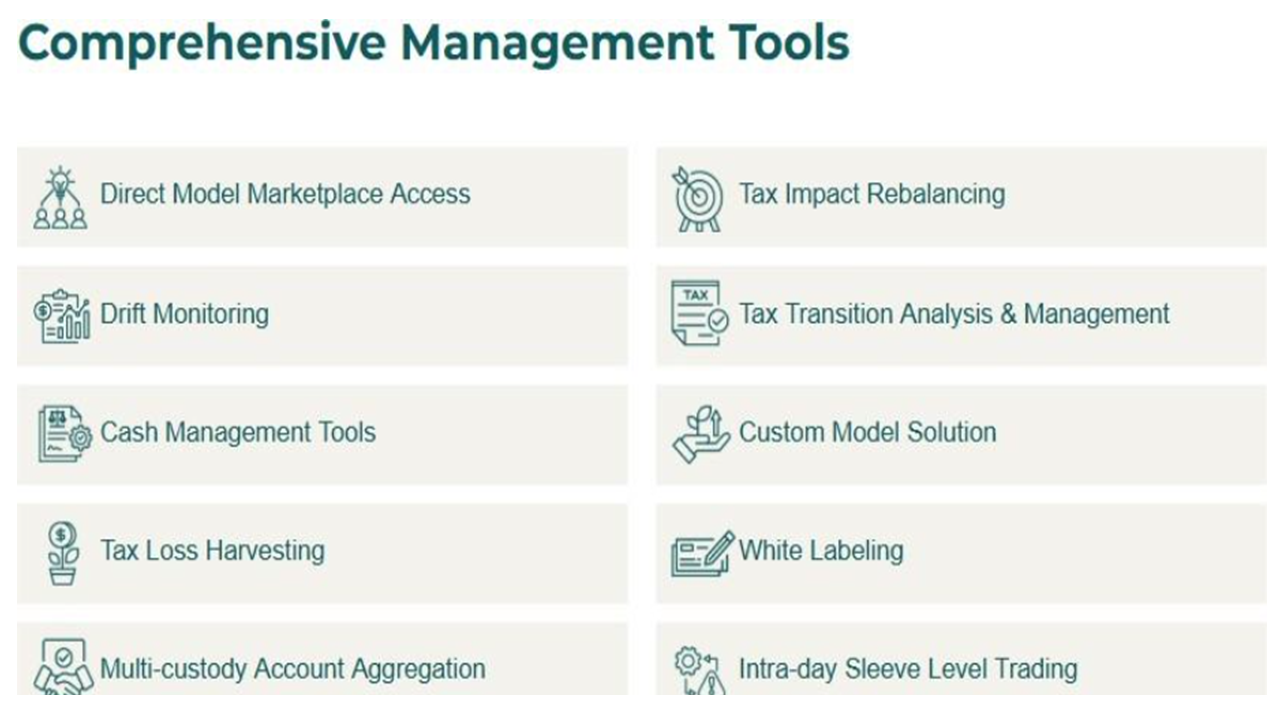
Prospects choose SMArtX because the platform is designed to align with how their business actually operates, not force them into a predefined technology or investment model. SMArtX combines deep managed account infrastructure with the flexibility required to support diverse workflows, governance structures, and growth strategies.
SMArtX is built to handle complex, high-volume managed account environments without linear increases in cost or operational burden. Sleeve-level accounting, real-time trading, and normalized data allow firms to scale accounts, assets, and investment complexity while maintaining control, reliability, and efficiency.
Firms select SMArtX because it supports centralized, delegated, advisor-discretionary, and hybrid operating models on a single platform. Investment Programs and Operating Models allow organizations to control advisor entitlements, trading authority, compliance, pricing, and oversight while still enabling customization where it matters.
SMArtX enables true multi-strategy, multi-asset unified managed accounts, including model-traded, manager-traded, rep-directed, tax-transition, cash management, protected, and alternative sleeves within one account. This allows firms to broaden investment offerings and introduce new strategies without re-platforming or operational redesign.
Advisors choose SMArtX for its flexible UMA infrastructure, multiple trading models, tax-aware tools, and advanced portfolio management capabilities that support personalized client outcomes.
Broker-dealers and home offices adopt SMArtX for efficient trade processing, strong governance, scalable oversight, and the ability to support hybrid advisor models without sacrificing control.
FinTech firms partner with SMArtX to embed managed account capabilities via APIs, web components, or white-labeled interfaces, accelerating time to market while retaining ownership of the client experience.
Enterprises leverage SMArtX to support complex organizational structures, multiple asset classes, and bespoke managed account programs at scale.
Asset managers use SMArtX to simplify distribution, operationalize sophisticated strategies, and gain visibility with advisors through structured investment programs.
Custodians rely on SMArtX as an operational backbone for integrations, scalable workflows, and normalized data across custody environments.
Prospects are drawn to SMArtX’s API-first, cloud-native architecture, which allows firms to deploy quickly, integrate deeply, and evolve over time. Clients can start with out-of-the-box capabilities and progressively embed SMArtX into proprietary platforms without disrupting existing systems.
Together, these factors position SMArtX as a long-term strategic platform for firms seeking to modernize managed accounts, differentiate investment offerings, and scale with confidence rather than a point solution addressing a single workflow.
SMArtX has evolved deliberately in response to direct client feedback, shifting industry dynamics, and advances in modern cloud and API-driven technology. Rather than pursuing isolated features, the roadmap has focused on expanding the platform’s ability
to support more operating models, greater investment complexity, and deeper integration into client ecosystems.
Direct client feedback
Clients have consistently asked for greater control and flexibility in how managed accounts are constructed and managed. In response, SMArtX has expanded support for fully rep-directed trading workflows for advisors who want to manage the entire account themselves, without introducing an overlay or centralized trading team into the process. Client feedback has also driven continued investment in tax-aware capabilities, including more sophisticated transition analysis, capital gains budgeting, tax-impact rebalancing, and sleeve-level tax management to better reflect real-world client portfolios.
Industry trends
As the industry has continued its shift toward unified managed accounts, customization at scale, and broader adoption of non-traditional investments, SMArtX has extended its platform to support increasingly complex investment solutions within a single account. This includes deeper support for alternative investments, semi-liquid vehicles, and interval-style strategies inside UMAs, as well as expanded capabilities for direct indexing, manager-discretionary strategies, and multi-asset model construction. These enhancements allow firms to evolve their investment offerings without fragmenting workflows or increasing operational risk.
Technology innovation
Advances in cloud infrastructure, data architecture, and APIs have enabled SMArtX to further modularize its platform and expand how clients integrate and deploy managed account capabilities. Recent innovation has focused on additional integration pathways through APIs, modular web components, and white-labeled interfaces, allowing SMArtX to fit cleanly into existing advisor, enterprise, and fintech technology stacks. Ongoing investments in scalability, automation, and real-time processing have ensured the platform can support higher volumes, more asset classes, and more complex workflows while maintaining enterprise-grade reliability and security.
Together, these factors have shaped SMArtX into a flexible, enterprise-grade managed account platform that evolves alongside client needs, adapts to market change, and uses modern technology to operationalize increasing investment complexity at scale.
SMArtX follows a release cycle built around small, frequent deployments rather than large, infrequent feature releases. The core principle is to deploy code continuously while using feature flags and configuration controls to manage when and how functionality is exposed to clients.
This approach allows SMArtX to innovate quickly while maintaining stability and minimizing operational risk.
Release cadence and philosophy
SMArtX deploys production code on a continuous basis as changes are completed and validated. New capabilities are delivered in small, incremental units aligned to specific requirements, rather than bundling multiple changes into large releases. Feature flags are used extensively to decouple deployment from release, allowing functionality to remain dormant in production until it is intentionally enabled for specific users, programs, or client groups.
This model enables SMArtX to:
Safe and controlled rollout
Because features are controlled through flags, SMArtX can roll out functionality gradually, support beta programs, and selectively enable features by client, operating model, or environment. If issues arise, functionality can be disabled immediately without redeploying code, providing a fast and low-risk mitigation path.
Modern CI/CD and quality controls
Small, frequent deployments are supported by an automated CI/CD pipeline with layered testing, consistent environments, and versioned artifacts. Code moves through development and QA environments before reaching production, but the emphasis is on validating changes continuously rather than gating large releases between environments. This ensures robustness, scalability, and security without slowing delivery.
Client impact and transparency
Client communication is aligned to feature activation rather than raw code deployment. Higher-impact changes are introduced through planned rollouts with advance notice and enablement, while lower-impact changes can be delivered seamlessly without disruption.
By combining continuous deployment, feature flags, and modern CI/CD practices, SMArtX is able to deliver new capabilities quickly and safely, giving clients confidence that the platform can evolve rapidly without sacrificing reliability or control.
At the Enterprise level,the Relationship Manager or SMArtX Executive Sponsor will be assigned to serve as the primary point of contact for matters outside of day-to-day service support, such as strategic initiatives, account reviews, or general inquiries.
SMArtX engages clients as active partners in shaping the product roadmap, particularly at the enterprise level. Our approach is designed to align platform evolution with client strategy while balancing broader market needs, platform integrity, and long-term innovation.
Strategic alignment and client partnership
Engagement begins with a shared understanding of each enterprise client’s strategic goals, business model, and growth priorities. Through joint account planning, SMArtX works with clients to define objectives, success metrics, and areas where technology can expand or enable their business. This strategic intent informs how we think about roadmap themes, investment areas, and sequencing of initiatives.
Ongoing collaboration and feedback loops
Client input is incorporated through a structured engagement cadence that typically includes weekly initiative status reviews with a client service owner, monthly governance or roadmap check-ins, and quarterly strategic partnership reviews. These forums are used to validate priorities, review progress, surface emerging needs, and reassess assumptions as client strategies or market conditions evolve.
Roadmap-driven prioritization
Insights gathered from client engagements are translated into concrete roadmap inputs through formal discovery and prioritization processes. Product initiatives are evaluated against strategic alignment, client impact, scalability, operational risk, and delivery effort. This ensures that customer-driven ideas are assessed consistently and integrated alongside broader platform investments, regulatory requirements, and technical risk reduction.
Balancing client needs and market opportunity
While individual client feedback is critical, SMArtX also looks for patterns across clients and segments. Initiatives that help existing customers broaden their offerings, scale more efficiently, or enter new markets are prioritized when they also strengthen the platform’s overall value proposition and attractiveness to prospects. In this way, the roadmap reflects both near-term client needs and longer-term market opportunity.
Art and science
Ultimately, prioritization at SMArtX is both structured and judgment-driven. Formal frameworks, discovery work, and ranking models provide discipline and transparency, while product leadership applies experience and context to balance competing demands. This approach allows SMArtX to move quickly, invest with intent, and ensure that product enhancements deliver meaningful value to clients and the broader market.
SMArtX is approaching AI as a long-term platform evolution rather than a short-term feature race. While much of the industry is focused on surface-level AI experiences like chat widgets, meeting summaries, or generic copilots, we believe the more meaningful transformation in wealth management will come from agentic workflows operating on high-quality, domain-specific data.
Our view is that AI only becomes truly valuable when it is deeply integrated into the systems that already manage portfolios, trading, tax workflows, billing, and operations. That has shaped how SMArtX is evolving the platform.
Foundational, data-first approach
SMArtX is investing in treating data as a first-class product, curated and structured specifically for managed account workflows. This includes clean, normalized, and context-rich datasets at the sleeve and account level, with strong governance and tenant isolation. By building an AI-ready data foundation first, we ensure future AI capabilities are accurate, explainable, and enterprise-safe.
From chat to agentic workflows
We see conversational interfaces as an entry point, not the end state. The real opportunity lies in agent-driven workflows that can observe, reason, and assist across complex processes like portfolio analysis, tax transitions, exception management, operational reviews, and advisor decision support. In this model, AI acts as a force multiplier for advisors, home offices, and operations teams by reducing manual effort and surfacing insights, not by replacing human judgment.
Embedding intelligence where work happens
Rather than bolting AI on top of the platform, SMArtX is focused on embedding intelligence directly into existing workflows. This includes transforming raw portfolio and performance data into actionable insights, accelerating reporting and analysis, and supporting proactive identification of risks, opportunities, and operational exceptions. AI is positioned as decision support, not autonomous execution, which is critical in a regulated, fiduciary environment.
Enterprise-ready and pragmatic adoption
AI adoption at SMArtX is intentionally incremental and controlled. We prioritize use cases that improve speed, consistency, and scalability while maintaining security, auditability, and trust. This means validating AI capabilities internally and within constrained environments before extending them to client-facing experiences.
As AI models continue to improve, SMArtX is well positioned to layer increasingly sophisticated intelligence on top of its managed account infrastructure. By combining agentic workflows with curated, domain-specific data and enterprise-grade controls, we believe SMArtX will help clients unlock real productivity gains and better client outcomes, well beyond what today’s AI hype cycle can deliver.
SMArtX’s 2026 roadmap is focused on expanding the platform’s ability to support more sophisticated investment programs, improve after-tax outcomes, and scale operational complexity without increasing friction. These initiatives reflect where we see the greatest opportunity to help clients grow their businesses and deliver better client experiences, while also strengthening the long-term foundation of the platform.
Unified Managed Households extend the managed account model beyond individual accounts to a household-level view of assets, tax exposure, and portfolio construction. This capability allows advisors and home offices to manage portfolios holistically across registrations and account types, enabling better coordination of asset location, tax management, and investment decisions. UMH supports improved client outcomes while reducing advisor effort and operational fragmentation.
Manager Directed Sleeves expand the range of investment strategies that can be delivered within a single unified managed account. By supporting discretionary and non-modeled strategies alongside models and advisor-managed sleeves, SMArtX allows firms to incorporate more investment solutions without breaking governance, reporting, or operational workflows.
This flexibility is critical for enterprises and asset managers looking to differentiate their offerings while maintaining scale and control.
As demand for private and semi-liquid investments continues to increase, SMArtX is focused on making alternative investments easier to operationalize at scale. Deeper integrations with alternative platforms allow these investments to be incorporated directly into managed accounts, rather than managed as off-platform exceptions. This reduces operational burden, improves visibility, and enables more consistent portfolio management across public and private assets.
Data enablement underpins all platform evolution at SMArtX. In 2026, we are investing in more extensible, normalized, and governed data capabilities that improve reporting, analytics, integrations, and downstream workflows. Treating data as a core platform asset allows clients to gain better insight into portfolios, scale operations more efficiently, and integrate SMArtX more deeply into their broader technology ecosystems.
Together, these initiatives reflect SMArtX’s focus on delivering tangible business value: broader investment flexibility, better client outcomes, and scalable operations. By strengthening the core infrastructure and workflows that matter most to enterprises and advisors, SMArtX is positioning the platform to evolve alongside client needs and market demands.
Several converging trends are shaping the challenges and opportunities facing wealth management firms in 2026. Together, they point toward increasing complexity in portfolio construction, execution, and operations, while raising expectations for personalization and efficiency.
Tax management is continuing to move from a differentiator to a core expectation. As market returns normalize and competition increases, advisors are increasingly judged on after-tax outcomes rather than gross performance. This puts pressure on firms to support more sophisticated tax-aware rebalancing, transition management, asset location, and household-level coordination. Platforms that cannot operationalize tax strategy at scale risk becoming bottlenecks rather than enablers for advisors.
AI is creating significant interest across the industry, but many firms are struggling to translate experimentation into durable value. Surface-level tools such as chat interfaces and meeting summaries generate attention but do not materially change advisor workflows or operational efficiency. The real challenge in 2026 will be moving beyond experimentation to embed intelligence into core portfolio, trading, reporting, and operational processes in a way that is trusted, explainable, and scalable within a regulated environment.
The distinction between public and private investments is continuing to blur as advisors seek to deliver differentiated portfolios and clients demand access to a broader range of assets.
Semi-liquid funds, interval vehicles, structured products, and private strategies are becoming more common in managed portfolios. This trend introduces operational complexity, liquidity management challenges, and reporting considerations that many legacy platforms were not designed to handle alongside traditional public securities.
Firms are increasingly moving away from one-size-fits-all models toward custom and semi-custom portfolios tailored to advisor philosophy, client objectives, tax constraints, and legacy holdings. While this enhances the advisor value proposition, it significantly increases the complexity of portfolio construction, governance, and oversight. Supporting customization without sacrificing scale, consistency, or control is a growing challenge for both technology providers and enterprises.
As ETFs continue to replace mutual funds as the primary building blocks of portfolios, firms are encountering new execution and operational challenges. Managing large numbers of ETF-based portfolios introduces complexity around trading efficiency, drift management, tax lots, cash management, and rebalancing at scale. Executing ETF portfolios well requires more sophisticated infrastructure than many firms anticipated when ETFs were first adopted.
Taken together, these trends point to a common challenge for 2026: delivering greater personalization, broader investment access, and better after-tax outcomes without overwhelming advisors or operations teams. Firms that can successfully navigate this complexity will be well positioned to differentiate and grow, while those constrained by rigid platforms and manual workflows will face increasing pressure.
AI is increasingly influencing client expectations, but in practice most wealth management firms are still early in the journey. Advisors, home offices, and technology leaders are actively exploring AI, yet many are struggling to identify where it delivers sustained, defensible value versus short-term efficiency gains or novelty.
Across our client base, AI interest is being driven by three primary pressures: the need to scale personalized advice, rising operational complexity, and competition for advisor and client attention. Many firms are experimenting with conversational tools, meeting summaries, and content generation, but are finding that these capabilities alone do not materially change portfolio outcomes or reduce operational burden. As a result, clients are becoming more discerning and are asking harder questions about where AI truly fits into core investment and operational workflows.
SMArtX is adapting by focusing less on AI as a standalone feature and more on the platform foundations required to make intelligent automation useful and safe. This includes continued investment in clean, normalized, and well-governed data; workflow consistency across portfolio management, trading, tax, and operations; and integration patterns that allow intelligence to be embedded where work already happens. Our approach is to ensure the platform can support more advanced automation and decision support as adoption matures, without forcing clients into premature or brittle AI-driven experiences.
Over the next three years, we expect AI to shift from visible, user-facing tools to largely invisible infrastructure that augments decision-making across the wealth management stack. The biggest impact will not come from replacing advisors, but from reducing manual effort, improving consistency, and surfacing insights across increasingly complex portfolios. Firms that succeed will be those that pair AI with strong data discipline, governance, and domain expertise.
Platforms that were not designed with data quality, transparency, and control in mind will struggle to move beyond experimentation.
In this environment, AI will increasingly act as a force multiplier for firms that already have strong operating models and modern infrastructure. SMArtX is positioning itself to support that evolution by ensuring the platform can absorb intelligence over time, allowing clients to adopt AI in ways that meaningfully improve outcomes rather than simply adding another layer of tooling.
The increasing interest in alternative investments is reinforcing a trend that has been core to SMArtX since our earliest days. The platform was originally built to handle complex, non-traditional investment structures, and that foundation is now becoming increasingly relevant as alternatives move from the margins into mainstream portfolio construction.
In recent years, client demand for private credit, interval funds, and other semi-liquid vehicles has accelerated. In response, SMArtX has focused on enabling these investments to live naturally inside multi-strategy, multi-asset unified managed accounts rather than being treated as off-platform exceptions. In 2024, we rolled out support for semi-liquid funds within model portfolios, allowing firms to incorporate interval-style vehicles directly into managed account strategies with appropriate controls and transparency.
This work reflects a broader philosophy: the future of managed accounts is not about adding one-off asset types, but about supporting increasingly complex investment products within a single, scalable UMA framework. As public and private markets continue to converge, advisors and enterprises need infrastructure that can accommodate different liquidity profiles, trading constraints, and operational workflows without fragmenting the client experience.
Looking ahead, our next major milestone is enabling scalable rebalancing of sub-document–based vehicles within a UMA. This is a critical step toward making private and semi-private investments truly usable at scale for advisors. Rather than forcing advisors to manage these assets manually or outside of core workflows, SMArtX is focused on orchestrating subscriptions, redemptions, and cash movements at the sleeve level in a way that aligns with model targets, liquidity windows, and enterprise governance.
For clients, the impact is twofold. On the opportunity side, alternatives allow firms to differentiate portfolios, improve diversification, and respond to growing client demand. On the challenge side, they introduce significant operational complexity that most legacy platforms were never designed to handle. SMArtX’s role is to absorb that complexity and make advanced investment products accessible, governable, and scalable within modern managed account programs.
As alternatives continue to move into the core of wealth management portfolios, firms that can operationalize them cleanly within a unified account structure will be best positioned to grow. SMArtX is intentionally building toward that future by extending the same rigor, flexibility, and scalability that already exist for traditional assets to the next generation of investment solutions.
The industry’s continued shift from mutual funds to ETFs is having a clear and meaningful impact on our client base. ETFs introduce advantages that align well with modern managed account programs, including intraday pricing, improved tax efficiency, lower costs at scale, and greater flexibility in portfolio construction. As a result, firms are increasingly using ETFs as the primary building blocks for both model-driven and advisor-managed portfolios.
This transition is also accelerating the rise of custom and semi-custom models. Asset managers are moving beyond a small set of standardized models and instead offering ETF-based strategies that can be tailored to an advisor’s investment philosophy, tax preferences, and client base. While this trend enhances differentiation and advisor value, it significantly increases the complexity of model management, trading, and oversight.
Executing ETF portfolios at scale introduces challenges that many firms underestimate. Intraday trading, drift management, cash flows, tax lots, substitutions, and frequent rebalancing all place greater demands on portfolio management and trading infrastructure. Managing hundreds or thousands of ETF-based models, each with variations, can quickly overwhelm legacy platforms and operational teams.
SMArtX is focused on solving this complexity. Our platform is designed to support ETF-heavy portfolios within multi-strategy unified managed accounts, with real-time trading, sleeve-level accounting, tax-aware rebalancing, and robust model governance. By absorbing the operational and execution complexity behind the scenes, SMArtX allows wealth firms to fully realize the benefits of ETFs while making custom models scalable, governable, and accessible across advisor populations.
As ETFs continue to replace mutual funds as the core portfolio building blocks, firms that can pair flexibility with scalable execution will be best positioned to compete. SMArtX is built to support that shift, enabling clients to embrace customization and efficiency without sacrificing control or operational stability.
One additional insight we often share with consulting partners, prospects, and clients is that SMArtX is intentionally built for firms that are innovating rather than standing still. While the platform supports a wide range of operating models, it delivers the greatest value for organizations that are evolving their investment offerings or embedding managed account capabilities into broader technology ecosystems.
SMArtX has a long track record of adapting to new investment product types as they emerge, from advanced hedge fund trading strategies and custom models to semi-liquid vehicles and alternative investments. Our platform was designed to absorb complexity, allowing firms to introduce new investment products and delivery models without re-platforming or disrupting existing workflows. For consultants, this often becomes a key signal of fit: clients who want to differentiate through investment innovation tend to benefit disproportionately from SmartX’s flexibility and depth.
We also see significant value for firms that want managed account technology to function as infrastructure rather than a standalone destination. Organizations building proprietary advisor platforms, home office workstations, or wealth ecosystems frequently partner with SmartX to embed portfolio management, trading, accounting, and data services directly into their environments. This approach allows firms to retain ownership of the client experience and economics while relying on enterprise-grade managed account capabilities underneath.
Not every client needs this level of flexibility on day one, but firms that anticipate change, whether driven by new investment products, advisor demand, or platform strategy, consistently find that SmartX gives them room to evolve. Our goal is to be a long-term partner for firms that want to grow, differentiate, and innovate without being constrained by rigid technology.
a. Did SMARTX originate as a cloud-native solution? YES
b. Does SMARTX support multi-tenancy? YES
c. Which cloud providers host SMARTX ? AWS
SMArtX maintains production integrations with the major custodians and clearing platforms used by wealth management firms, including Fidelity IWS, NFS, Charles Schwab, Pershing Clearing, Pershing Advisor Solutions, Goldman Sachs Advisor Solutions, First Clearing / Trade PMR, Axos, and Raymond James.
These integrations support daily data ingestion for positions, transactions, balances, cost basis, and entitlements, as well as real-time trade execution via FIX connectivity.
On the reporting and analytics side, SMArtX integrates with leading platforms such as Black Diamond, Addepar, and AdvisorEngine, allowing clients to continue using their preferred reporting environment while relying on SMArtX as the portfolio management and accounting engine beneath it. SMArtX also provides data through Advent Custodial Data that can be plugged into other Advent products.
SMArtX also integrates with ByAllAccounts to support aggregation and reporting of externally held assets, Flyer Trading Technologies for trading connectivity and execution management, and BlackRock Advisor Center for risk and portfolio analytics. Through partnerships with ByAllAccounts and Flyer Trading Technologies, SMArtX has streamlined the process of adding new custodians and execution venues. New custodian integrations can typically be completed in two to four weeks when standard data feeds and FIX connectivity are available.
Direct data feeds and data extract integrations
In addition to APIs and embedded user interfaces, SMArtX provides robust, enterprise-grade data extract feeds that allow clients and partners to integrate SmartX data directly into their internal systems, data warehouses, reporting platforms, and analytics environments. These feeds include standardized Start-of-Day (SOD) and End-of-Day (EOD) data extracts delivered via secure SFTP and designed for high-volume, production use. Data is provided at the account and sleeve level and includes positions, transactions, performance, securities, pricing, models, and enterprise hierarchy information. Feeds are versioned, backward-compatible, and delivered on predictable schedules aligned with market activity, allowing firms to operationalize SmartX data without fragile point-to-point integrations. This approach is particularly valuable for enterprises that want full transparency into managed account activity, need to support downstream reporting or reconciliation processes, or are building proprietary data and analytics capabilities on top of SmartX’s managed account infrastructure.
API-first, enterprise integration model
Beyond packaged integrations, SMArtX is built as an API-native platform. We provide a comprehensive set of REST APIs, event notifications, and structured data feeds that allow clients and partners to integrate SMArtX into their existing technology stacks without hard dependencies. This enables firms to embed portfolio management, trading, accounting, and data services into proprietary advisor platforms, home-office tools, or fintech products while retaining ownership of the user experience and economics.
Web components and embedded experiences
For firms that want deeper integration without rebuilding functionality from scratch, SMArtX offers modular web components built using a micro-frontend architecture. These components allow discrete SmartX workflows, such as portfolio construction, rebalancing, or model selection, to be embedded directly into partner platforms. Components are theme able, independently deployable, and upgraded without disrupting the host application, significantly reducing integration effort and time to market.
Cybersecurity is a core tenet of the SMArtX platform and is embedded into how the system is designed, operated, and evolved. As a provider of mission-critical managed account infrastructure, SMArtX treats security, data protection, and access control as foundational requirements rather than optional features.
SMArtX maintains a SOC 2 audited control environment, providing independent validation of our security, availability, and confidentiality controls. In addition, we conduct regular penetration testing and vulnerability assessments to identify and remediate potential risks. These efforts are part of an ongoing security program that includes monitoring, incident response planning, and continuous improvement.
The platform supports modern identity and access management capabilities designed for enterprise-scale deployments. This includes single sign-on (SSO) integrations with industry-standard identity providers and role-based access controls. Permissions can be defined and enforced at multiple levels, including enterprise, role, user, and function, ensuring that users only have access to the data and capabilities appropriate to their responsibilities.
SMArtX employs strong data protection practices, including encryption of data in transit and at rest, secure API authentication, and logical data segregation by enterprise and client. Rather than relying on separate databases or schemas, data access is governed through application-level controls and entitlement enforcement, ensuring clients can only access their own data while enabling the platform to scale efficiently.
Security is integrated into SMArtX’s development and deployment processes through controlled CI/CD pipelines, code reviews, and change management practices. Feature flags and staged rollouts further reduce risk by allowing controlled exposure of new functionality without broad impact.
Together, these cybersecurity features enable SMArtX to support enterprise clients with confidence, ensuring that managed account data and workflows remain secure, auditable, and resilient as clients scale and evolve.
To learn more about SMArtX Advisory Solutions and their approach to modern managed account infrastructure, we encourage you to visit their website at https://www.smartxadvisory.com/. As always, our goal is to highlight platforms and partners that meaningfully support the evolving needs of wealth management firms. Be sure to watch for our next platform profile as we continue to share insights on the technologies shaping the future of the industry.
DISCLAIMER: This communication represents a voluntary collaboration between TorreBlanc and SMartX Advisory Solutions for informational purposes only. TorreBlanc is a provider/vendor-neutral consultancy with no formal affiliation to SMartX Advisory Solutions. This article does not constitute a paid advertisement nor an endorsement of TorreBlanc by SMartX Advisory Solutions.