Read More


Northern Trust's Integrated Trading Solutions (ITS) is a global outsourced trading solution designed to operate as a seamless extension of an asset manager's or asset owner's investment organization. Delivered through Northern Trust's regulated broker-dealer, ITS combines institutional-quality execution, global market access, independent performance measurement, and integrated post-trade support within a single operating model.
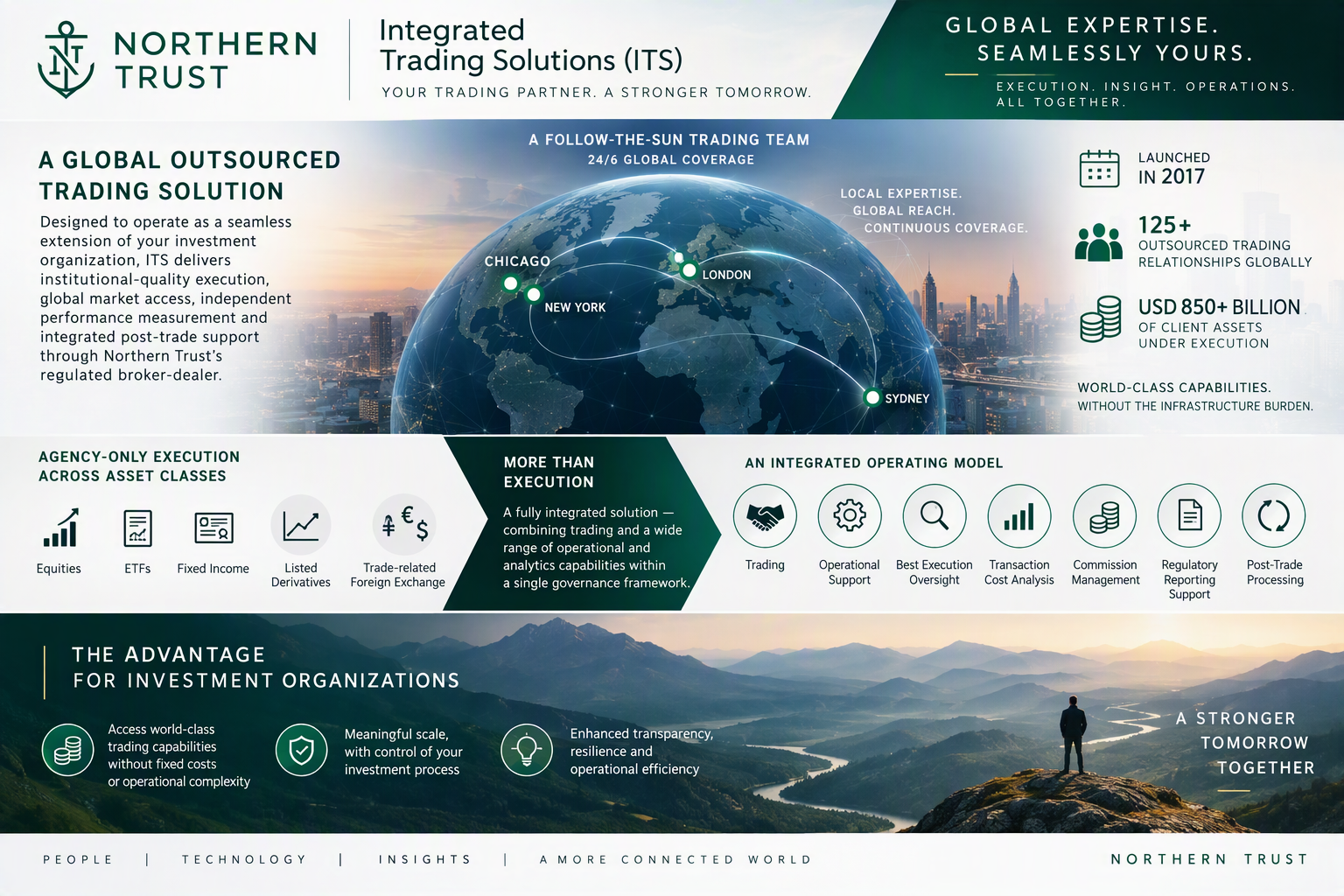
Launched in 2017, ITS provides investment organizations with access to world-class trading capabilities without the infrastructure burden, fixed costs, and operational complexity associated with maintaining an in-house global dealing desk. The service supports more than 125 outsourced trading relationships globally and more than USD 850 billion of client assets under execution.
ITS provides agency-only execution across equities, ETFs, fixed income, listed derivatives, and trade-related foreign exchange. Execution is supported by experienced traders operating from Chicago, New York, London, and Sydney through a 24/6 follow-the-sun model.
Beyond execution, ITS integrates trading, operational support, best execution oversight, transaction cost analysis, commission management, regulatory reporting support, and post-trade processing into a single governance framework designed to enhance transparency, resilience, and operational efficiency.
ITS was created in response to significant shifts in the investment management industry, including fee compression, increasing regulatory obligations, rising technology costs, and growing demand for specialist trading capabilities.
As trading became more sophisticated, firms faced increasing investment requirements in market connectivity, execution technology, talent, governance, and operational resilience. Many organizations began questioning whether owning and operating a trading desk provided meaningful competitive differentiation.
Northern Trust identified growing demand for an outsourced trading model that combined institutional-quality execution with the governance, transparency, and operational robustness expected by sophisticated investment organizations.
ITS was established as a scalable agency-only solution, allowing clients to focus on investment management while accessing global liquidity, experienced traders, and integrated operating support.
ITS initially launched as an outsourced equity trading solution, but has evolved into a comprehensive multi-asset trading ecosystem supporting increasingly sophisticated client requirements across asset classes, regions, and operating models.
Northern Trust expanded the platform to include fixed income and listed derivatives trading while continuing to enhance post-trade support, settlement oversight, regulatory reporting, and operational integration.
Today, ITS increasingly serves larger and more complex investment managers, pension funds, and asset owners that view outsourced trading as a strategic operating model rather than solely a cost-reduction initiative.
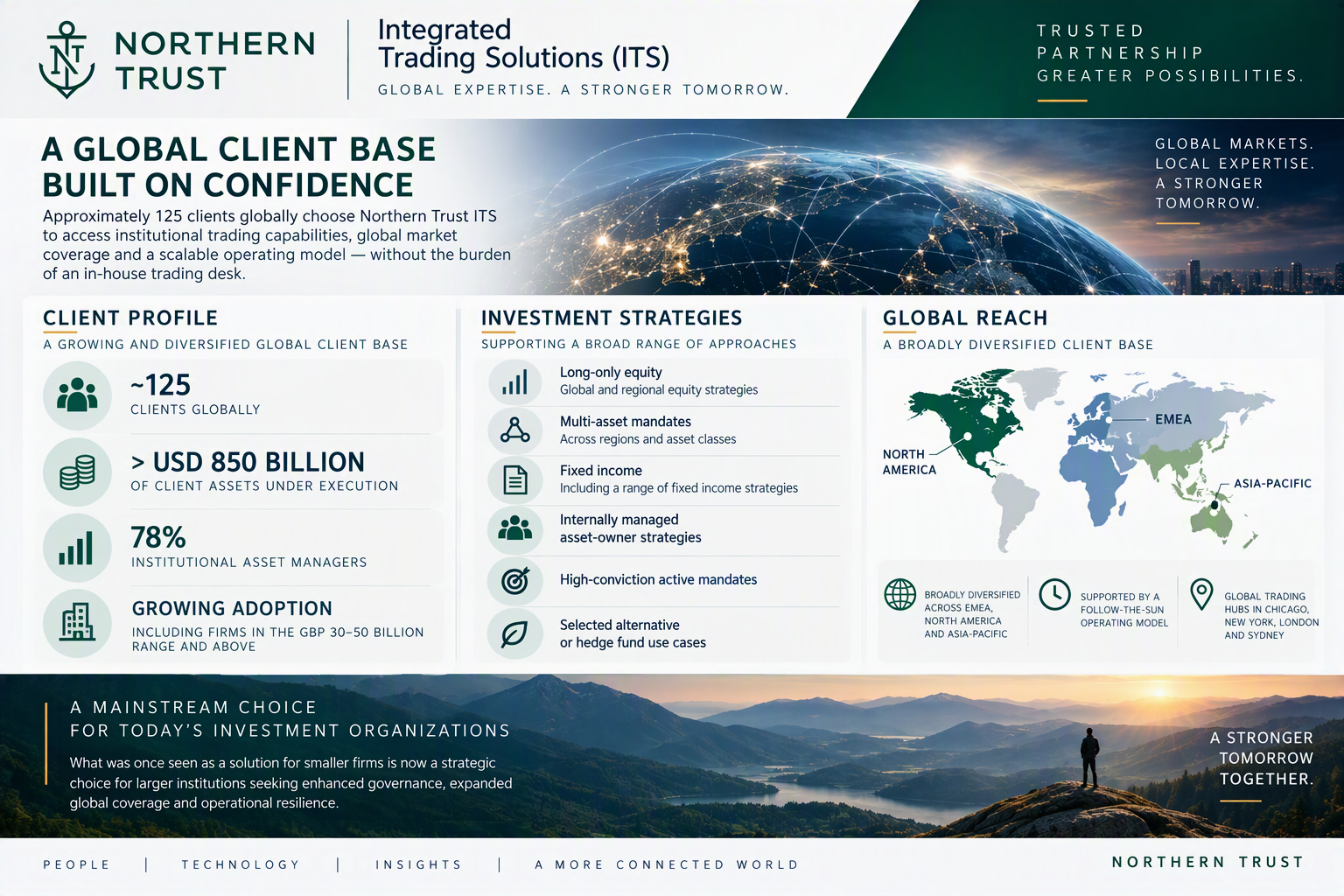
Northern Trust's ITS client base reflects the growing institutionalization of outsourced trading across the investment management industry. The platform supports approximately 125 clients globally, representing more than USD 850 billion of client assets under execution.
Approximately 78% of client relationships are institutional asset managers, with the remainder including pension funds, sovereign wealth funds, endowments, foundations, wealth managers, family offices, and other asset owners.
Supported by global trading hubs and a follow-the-sun operating model, outsourced trading has increasingly become a mainstream institutional operating-model choice for firms ranging from boutique managers to institutions with GBP 30-50 billion and above in assets.
Northern Trust ITS is differentiated by its combination of institutional scale, agency-only execution, global multi-asset coverage, full-lifecycle integration, and the stability of a long-term strategic provider.
While outsourced trading providers may compete on execution capability, Northern Trust’s proposition is intentionally broader. ITS is designed to support each client’s operating model, governance requirements, and risk management objectives in addition to trade execution.
ITS is not positioned as a narrow execution vendor. It is an integrated trading solution designed to help clients address broader operating-model challenges involving transparency, resilience, scalability, and governance.
ITS provides a modular yet integrated service across the trading lifecycle. Clients can adopt the core outsourced trading model while tailoring protocols, asset-class scope, reporting, governance, and operating workflows to their requirements.
The modularity of the service allows clients to adopt ITS in a way that reflects their operating model. Some clients use ITS as a fully outsourced trading desk, while others use it as a co-sourced or supplemental capability for specific regions, asset classes, time zones, or resilience objectives.
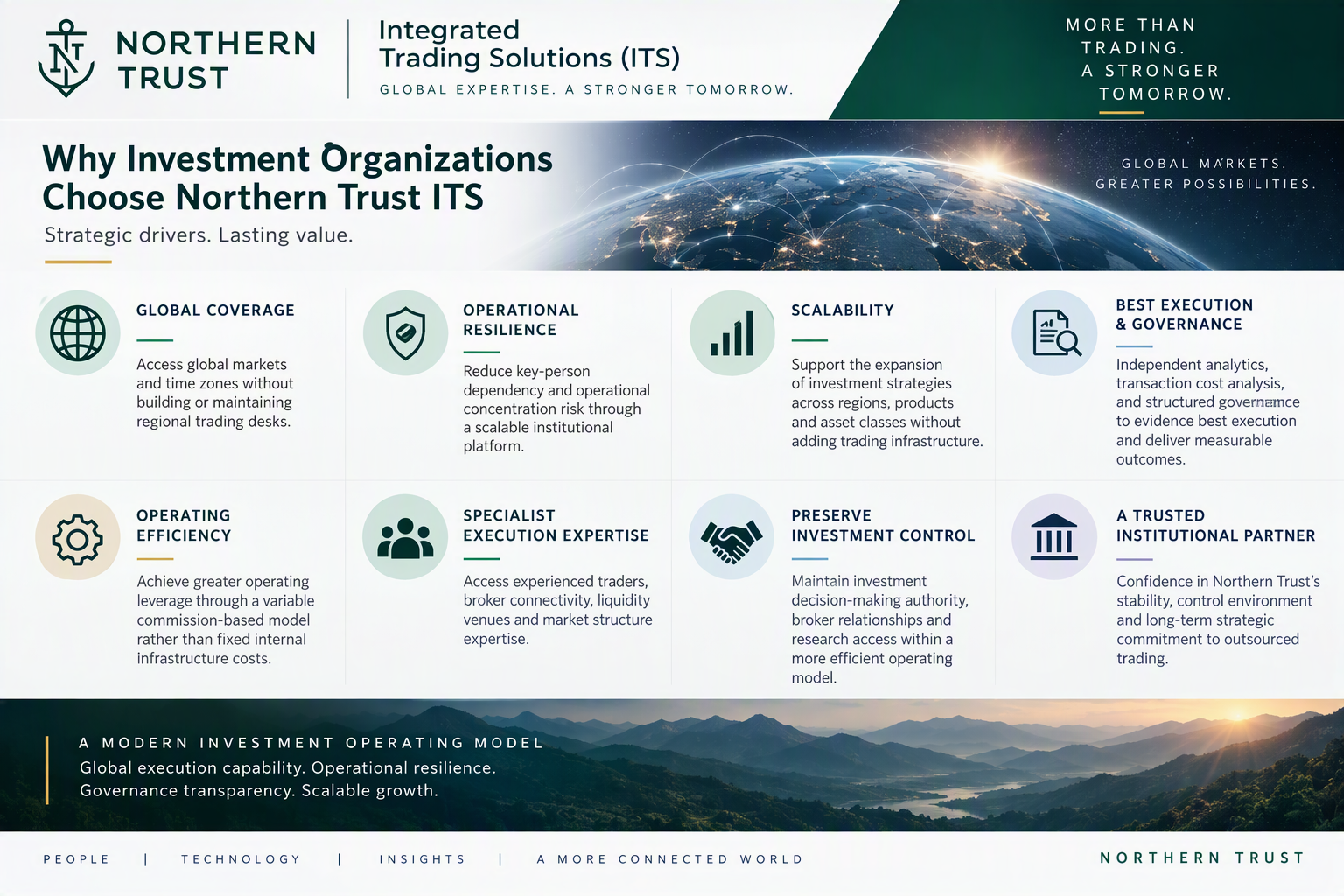
Prospects typically evaluate ITS when reassessing how trading should be delivered within their broader operating model. These drivers are often strategic rather than purely financial.
For many clients, the decision is not framed as the simple replacement of an internal trading desk. It is often part of a broader redesign of the investment operating model, enabling internal teams to focus on portfolio management, research, data, client engagement, and growth.
Client feedback has consistently reinforced the importance of transparency, integration, and governance. Sophisticated clients want more than execution outcomes. They want visibility into how outcomes are achieved, how performance is measured, how issues are escalated, and how the provider contributes to the client’s oversight obligations.
In response, Northern Trust has continued to enhance reporting, independent transaction cost analysis, service-review materials, workflow integration, and client-facing data capabilities.
The appointment of Virtu Analytics as the independent TCA provider reflects the importance Northern Trust places on objective measurement, analytical depth, and flexible reporting.
Outsourced trading has become increasingly accepted by larger institutions and is now viewed as a structural component of the investment operating model.
Northern Trust has responded through continued investment in multi-asset capability, fixed-income automation, regional trading depth, operational resilience, and business-continuity planning.
Technology innovation has focused on resilient connectivity, data quality, automation, reporting, and the secure application of artificial intelligence and machine learning.
Northern Trust’s approach combines established third-party platforms with controlled internal integration, allowing clients to benefit from innovation without compromising governance, security, or operational stability.
Northern Trust is investing in artificial intelligence and machine learning capabilities to enhance data processing, reporting accuracy, operational efficiency, and insight generation within a controlled technology environment.
AI is particularly relevant in areas where large datasets, repetitive workflows, and pattern detection can improve speed and consistency. Within ITS, the highest-value applications are expected to enhance transparency, reduce operational friction, and improve oversight rather than remove human judgement from execution decisions.
Northern Trust’s approach is deliberately governed. AI is not viewed as a substitute for trader judgement, client oversight, or robust governance. Instead, it is intended to improve the quality, timeliness, and consistency of information available to traders, operations teams, relationship managers, and clients.
Human oversight, accountability, secure deployment, and compliance with Northern Trust’s control environment remain central to the model.
Northern Trust continues to invest in ITS as a core strategic capability. Current and prospective clients should expect ongoing enhancements focused on transparency, automation, data accessibility, business continuity, and operational resilience.
These enhancements are designed to improve the speed, precision, and consistency of client outcomes without diluting accountability or governance.
Northern Trust is not participating in outsourced trading as a short-term market opportunity. ITS is a long-term strategic capability supported by sustained investment, senior-management sponsorship, formal governance, and Northern Trust’s institutional infrastructure.
Clients and prospects are likely to face a convergence of structural, regulatory, and operating-model pressures in 2026 and 2027. These pressures will make trading infrastructure, post-trade resilience, transparency, and governance increasingly important to boards, management teams, and investors.
Together, these trends reinforce the case for outsourced trading as a strategic operating model rather than a tactical cost lever. Firms need partners that can provide scale, governance, and resilience while allowing internal teams to focus on the activities that differentiate investment performance.
Northern Trust is adapting through continued investment in global trading coverage, multi-asset capabilities, fixed-income automation, independent transaction cost analysis, client reporting, technology integration, business continuity, and artificial intelligence.
ITS is designed to give clients access to scale, resilience, governance, and infrastructure that would be costly and complex to replicate internally.
As settlement timelines compress and regulatory expectations increase, the value of an integrated trading and post-trade model becomes more pronounced. A provider’s ability to manage workflows, coordinate across counterparties, evidence execution quality, and provide transparent reporting will become as important as trading expertise itself.
AI is likely to have a material impact over the next three years, particularly in analytics, workflow automation, surveillance, exception management, reporting, and client service.
The most successful applications will be those that enhance human decision-making rather than replace it. Execution in complex markets still requires judgement, context, market knowledge, and accountability.
Within outsourced trading, AI is expected to improve the quality and timeliness of information, automate lower-value operational tasks, identify patterns and anomalies more quickly, and support more scalable governance reporting.
Providers that combine AI capabilities with strong controls, high-quality data, human oversight, and institutional governance will be best positioned to create durable client value.
Outsourced trading should no longer be evaluated purely through a cost-saving lens. Cost efficiency remains relevant, but it does not represent the full strategic argument.
The more important question is how an investment organization allocates its finite capital, talent, technology, and management attention to the activities that create competitive advantage.
For active managers, differentiated value is more likely to come from investment research, portfolio construction, data, technology, artificial intelligence, client engagement, and risk management than from owning every element of trading infrastructure.
Trading remains critical to investment outcomes, but owning a trading desk may not be the most efficient or resilient way to access institutional trading capabilities.
A mature outsourced trading model enables firms to retain control over investment decisions, governance, and oversight while accessing specialist execution expertise, operational infrastructure, liquidity connectivity, and data capabilities through a scale partner.
Clients should assess outsourced trading providers across a broad range of criteria:
The best provider is not simply the firm that can execute orders. It is the firm that can operate as a trusted extension of the client’s investment organization.
The following themes explore how outsourced trading is evolving in response to changing operating models, regulatory expectations, cost pressures, talent constraints, and rising demands for technology integration and data transparency.
Outsourcing is increasingly viewed as a structural component of the investment operating model rather than a tactical solution.
Outsourced trading has moved decisively beyond its early perception as a tactical cost or coverage solution. It is increasingly being adopted as a structural component of the investment operating model, particularly by firms seeking greater scalability, resilience, governance, and operating leverage.
Historically, firms often considered outsourcing when they lacked internal trading coverage, wanted to reduce fixed costs, or needed access to specific regional markets. Those drivers remain relevant, but they are no longer the full story.
Firms are now asking more strategic questions: which activities genuinely create competitive advantage, where should scarce resources be deployed, and which capabilities are better delivered through specialist scale partners?
In this context, outsourced trading provides a way to reallocate capital and management attention toward research, portfolio construction, data, technology, client service, and alpha generation. The model allows asset managers to retain investment control while accessing institutional-grade execution infrastructure without owning the full fixed-cost base.
Outsourced trading should therefore be assessed not only as a service decision, but also as part of the client’s target operating model, investment-governance framework, and long-term technology and talent strategy.
Outsourced trading is becoming a mature institutional model as firms expand across asset classes, regions, and products.
Adoption among mid-to-large investment managers is being driven by the normalization of outsourced trading as a mature institutional model. Larger firms are increasingly comfortable using specialist partners for parts of the trading lifecycle where doing so improves resilience, scalability, or efficiency without compromising investment control.
For larger managers, the rationale is often not the full replacement of an internal trading desk. Outsourced trading may instead support co-sourcing, regional coverage, asset-class expansion, business continuity, out-of-hours trading, or specialist liquidity access.
Outsourced trading can therefore become a flexible component of a broader operating model rather than a binary build-versus-buy decision.
Northern Trust has seen this trend reflected in growing adoption by firms with substantial assets under management, including UK and European managers in the GBP 30 billion to GBP 50 billion range and above. This reinforces the view that outsourced trading is no longer viewed as a solution only for smaller firms.
Effective outsourced models preserve client authority while delegating execution within clearly documented protocols and controls.
The most effective outsourced trading models are designed to preserve client control while delegating execution activity within clearly defined protocols.
Portfolio managers continue to make investment decisions, define trading intent, set urgency, specify limits, and retain oversight of how execution is delivered. The outsourced provider acts as agent, applying execution expertise within the client’s agreed framework.
Governance should focus on measurable outcomes rather than the micromanagement of individual trades. Clients should monitor execution quality, settlement efficiency, exception rates, responsiveness, adherence to protocols, broker usage, TCA trends, and incident management.
This approach allows boards and oversight functions to demonstrate that the outsourced arrangement is being actively supervised.
Northern Trust’s ITS model is designed around this principle. The client retains investment authority and oversight, while Northern Trust provides the execution infrastructure, market expertise, operational support, and reporting required to make the model transparent and governable.
Outsourced trading is increasingly judged by its integration, data, and reporting maturity, not only by execution performance.
Technology integration and data visibility are central to whether outsourced trading delivers genuine operational resilience. A model that improves execution but fragments downstream workflows may create new risks.
A resilient outsourced trading model must connect effectively with the client’s order management system, middle office, custodian, compliance framework, reporting environment, and governance processes.
Northern Trust’s model is built around established technology integration, including:
The objective is to create a connected front-to-back operating model rather than a standalone trading overlay.
Clients need timely access to information that allows them to evidence control and assess whether the outsourced model is achieving its intended outcomes. This includes:
Operational resilience is therefore not simply about having an alternative trading desk available. It requires a transparent, integrated, and measurable operating model capable of withstanding market disruption, settlement compression, staff constraints, and regulatory scrutiny.
Structural pressures are causing firms to reconsider the traditional assumption that trading infrastructure must be owned internally.
Regulatory scrutiny, cost pressure, and talent constraints are reshaping the traditional assumption that trading should be owned internally.
Best-execution expectations continue to increase. Firms must be able to demonstrate not only that they achieve appropriate outcomes, but also that those outcomes are measured, reviewed, and challenged through suitable governance.
Maintaining an internal trading desk requires ongoing investment in experienced traders, technology, market data, broker connectivity, compliance, controls, business continuity, and operational support.
For many firms, these costs are increasing while margins remain under pressure and investment budgets are being prioritized toward areas more directly linked to competitive advantage.
Talent is also a structural consideration. Building and retaining specialist trading expertise across asset classes, regions, and time zones can be challenging, particularly for firms that cannot fully utilize those resources. Concentrating trading knowledge among a limited number of individuals can also create key-person and resilience concerns.
The build-versus-buy decision is therefore becoming more nuanced. Firms are not questioning whether trading matters. They are asking whether owning the full trading infrastructure is the best way to access the required capabilities.
For many organizations, a specialist provider can offer scale, expertise, controls, and resilience while the investment manager retains investment decision-making authority, governance, and accountability.
Northern Trust Integrated Trading Solutions combines global, multi-asset execution with operational support, independent performance measurement, post-trade services, and structured governance.
The model is designed to operate as an extension of a client’s investment organization, providing access to institutional trading capabilities while allowing the client to retain investment authority, governance, and oversight.
As outsourced trading becomes a more established component of the investment operating model, ITS provides a scalable framework for organizations seeking broader market access, stronger operational resilience, greater transparency, and more efficient use of internal resources.
Disclaimer: TorreBlanc is an independent management consultancy with no commercial affiliation to Northern Trust. This article reflects a voluntary collaboration and is intended for informational purposes only. It does not represent a paid advertisement or an endorsement of either organization by the other.